If you have already taken the step and have your own surfski, you surely care about keeping it in the best conditions. Taking care of your canoe is very important, not only to lengthen its useful life, but to avoid situations at sea that could have been avoided on land.
In this post I will teach you how to take care of your canoe, from how to clean it, to how to store and transport it.
1. Keep all the screws and cables up do date
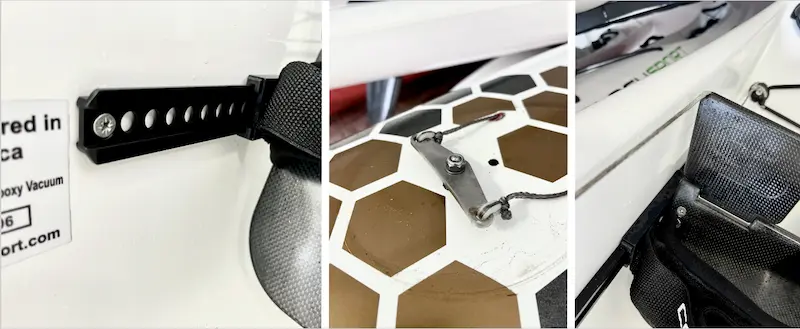
One of the first tips to keep your surfski as good as the first day, is checking that each element that has some fastening that penetrates the epoxy or the carbon is well tightened.
Because if your surfski has a screw or any other element that is a bit loose, it will cause friction that can eventually create water leaks or cause damage to other parts. For example, if the footrest is not well tightened and has some movement, it can damage the bottom of the canoe.
If you regularly check that every screw is well tightened (without over tightening) you will avoid this type of damage or frictions that will always end up creating water leaks.
Besides the screws in the footrest area, don’t forget to check the nut that holds the rudder. Check regularly that it is well tightened to avoid losing it, which could cause you to lose your rudder.
You should also check the condition of the rudder cables, that they are not damaged and that the rope knots are tight.
2. If water gets in, fix it immediately
If you hit it during training or notice a water leak, it is crucial that you fix it as soon as possible. The internal structure of the surfskis is made of panels of a type of foam that, if they get in contact with water, will begin to absorb it. Although it is not as exaggerated as a surfboard, the result of having water inside is that your canoe will gain some weight.
3. Storage
Always store your surfski away from the sun. A surfski is a very large enclosed container, so changes in the temperature of the air that is inside will cause it to expand (in the heat) or contract (in the cold). This changes affect the inner compartments and membranes, as they will suffer an overpressure that can cause them to come loose. You can check if you have any loose ones by moving your canoe and hear something moving inside.
If you are not going to use your surfski for a while and you are going to store it in a cover, it is important that you let it dry well after sweetening it because if it has some humidity it can cause osmosis. In these cases, you can also apply some penetrating grease (they don’t have to be solid) on the moving system, to make sure that any small residue that remains does not solidify. If you are in a beach area, be careful with the sand and the grease.
4. To sweeten or not to sweeten, that is the question
But what are you saying Esteban, how am i not going to sweeten my canoe after using it? Well, Oscar Chalupsky has always said that sweetening is stupid. I think the same thing, but with some nuances.
If you train daily, don’t waste your time sweetening. I am a good example of this case: I train daily and I never sweeten. But when I change canoes, mine is one of the ones in the best condition.
This happens because the salt water is recycled every day, it does not have time to dry completely and create new salt crusts.
If you are not as regular using your surfski then I would recommend you to sweeten it after each use, as corrosion will play its part. The salt will solidify and it will cause stiffness in your systems. Focus on rinsing all moving parts properly.
Logically, sweetening will lengthen, even slightly, your canoe’s life. But think if the water and time waste that you spend everyday is worth the damage of a part that, if it breaks, will cost you more than eighty euros and will warn you before it breaks.
5. How to transport it safely
- Whether you do it in your van or on a canoe trailer, the bars on which your surfski sits should be paddled.
- Always place the canoe upside down, unless you have a special rack that is designed upside down.
- Tighten the straps with the right strength: not too much and not too little. I’m sure you know what happens if you let them loose, but overtightening can cause a dent.
- There is a way to tie the surfski on the trailer so that it stays in the air, without touching any bar. You will need twice as many straps as if you tied it the usual way, but it will be more safe.
- If you do a long trip, make stops from time to time to check that the straps are tight, because they tend to loosen up with the bumps.
- Remember to always be clear about your country’s legislation regarding transporting them in your car. In Spain, the load can protrude from the back 10% of the length of your vehicle and must always be signaled with the V20 plate.
Conclusions
After more than ten years using them and with about two hundred surfskis in daily use here in Gran Canaria, these are my tips to keep your canoe in its best conditions.
Remember that visual damage (scratches, falling paint…) hurts us and you can fix them whenever you want, but the most important are all the functional parts that you need to don’t break.
Calling for rescue in the open sea because your rudder broke or because there is a water leak are mostly avoidable problems that you can prevent before you find yourself in that situation.